
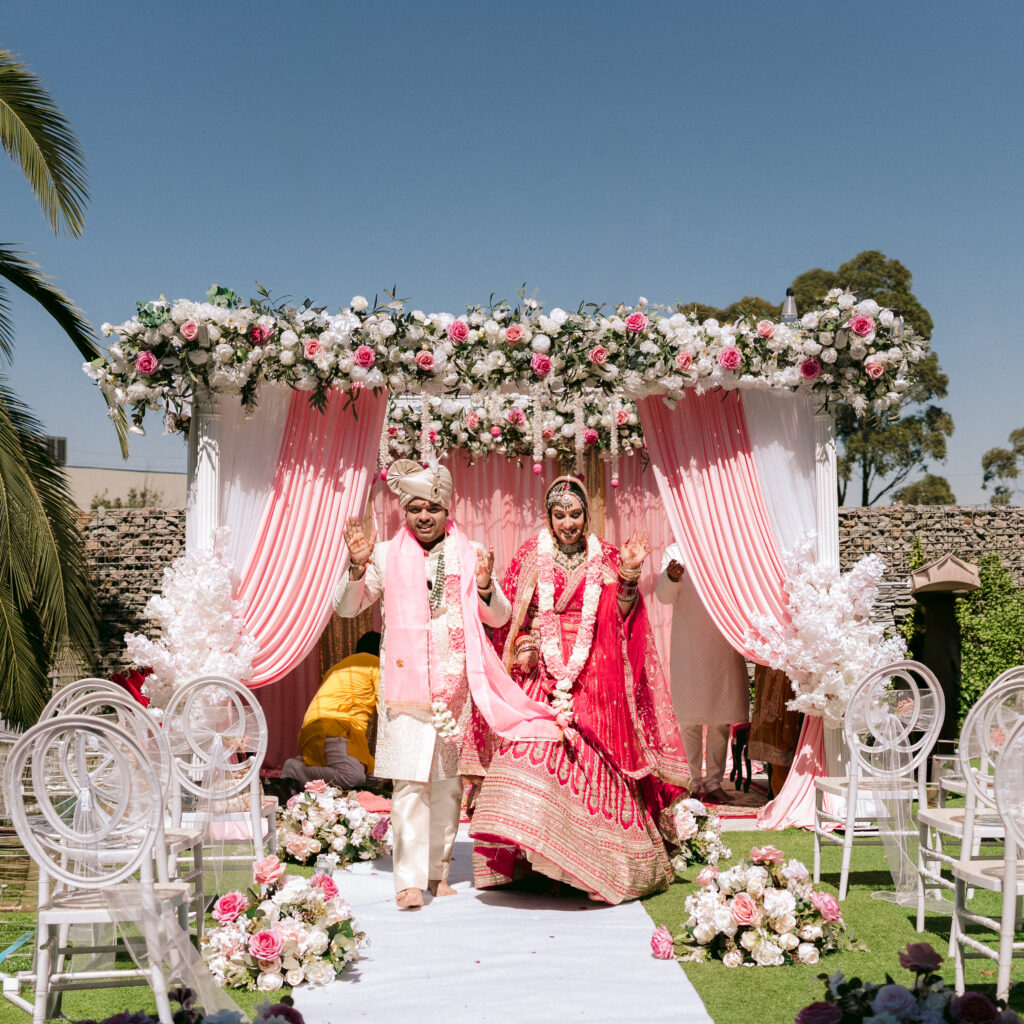
Planning an Indian wedding in Melbourne means planning a multi-day experience unlike anything else. It is layered, emotional, fast-moving, and full of moments that happen once and never again.
After 7 years and 150+ Indian weddings across Melbourne, the couples who walk away genuinely happy — not just with their day but with their photos and videos — are the ones who understood what was coming before it arrived.
Below are three complete timelines. Find yours, read it start to finish, and plan your day around it.
SIKH WEDDING — FULL TIMELINE
Mehndi
Timing: Afternoon, one to two days before the wedding. The bride’s hands and feet are adorned with intricate henna while family gathers. Book your Mehndi artist at least four to six months in advance — good artists in Melbourne fill up fast. Brief your photographer to arrive from Mehndi, not just Sangeet.
Sangeet
Timing: Evening, one to two days before the wedding. Choreographed family dances, a DJ, both families coming together. A DJ who understands Punjabi music and a venue with good dance floor lighting makes an enormous difference.
Groom Getting Ready — Pagri and Sehra
Timing: Morning of the wedding — minimum 60 to 90 minutes. Try and wear the pagri properly before the wedding morning — at least 30 minutes. Move around. Make sure it is secure and comfortable. Flowers for the sehra should be sourced fresh the morning of, not the night before.
Bridal Getting Ready
Timing: Morning of the wedding — minimum 2 to 3 hours. Hair, makeup, dressing, the dupatta being pinned, the chooda being placed. Give your photographer at least 90 minutes of getting ready coverage before you need to leave. Good natural light near large windows makes an enormous difference.
Baraat and Milni at the Gurudwara
Timing: Early morning — typically between 8am and 10am. Budget 45 minutes for the arrival and Milni. Brief the baraat to give the groom space to enter with presence rather than surging forward as a crowd. The groom’s entry into the Gurudwara is one of the most photographable moments of the entire day.
Anand Karaj — The Sikh Ceremony
Timing: Morning — approximately 1.5 to 2.5 hours. The four Lavaan are the heart of the ceremony and the most important moments to capture. Gurudwara hall size matters — when you visit to book, ask honestly if there will be space for a photographer to move if all your guests are seated. Give the couple space during the Lavaan. Brief your family to sit a respectful distance back during the rounds. Let the bride enter, walk, and settle first — everyone else follows.
Couple Portraits and Family Formals
Timing: Immediately after the ceremony — minimum 60 to 90 minutes. This time is non-negotiable. Family formals always take longer than planned — give them real time. Couple portraits need at minimum 45 to 60 minutes of uninterrupted time.
Vidaai
Timing: 30 to 45 minutes minimum. Do not leave the Vidaai to whatever time is left over. Plan it as a real segment with a real start time. A Vidaai that is rushed because the reception venue is waiting produces very different coverage to one given the space it deserves.
Reception
Timing: Separate evening — minimum 3 to 4 hours coverage. DJ quality matters enormously. Share your full reception run sheet with your photographer and videographer at least one week before. Dry ice only for your first dance — never a fog machine. Avoid cheap laser lighting.
MUSLIM WEDDING — FULL TIMELINE
Mehndi
Timing: Afternoon, one to two days before the wedding. Give your photographer real time here — not a rushed 30 minutes. The intimate, unposed moments during Mehndi are consistently the most genuine images in any Muslim wedding gallery.
Bridal Getting Ready
Timing: Morning or early afternoon — minimum 2 hours. Get ready in good natural light where possible. Overhead lighting flattens everything. A room with large windows transforms getting ready coverage entirely.
Groom Getting Ready
Timing: Morning or early afternoon — minimum 45 to 60 minutes. Brief your photographer to split time between both sides.
Nikah — The Marriage Ceremony
Timing: Afternoon or evening — typically 1 to 2 hours. Make sure your photographer knows the full order of the Nikah before the ceremony begins. Keep guests off their phones — ask your MC or a trusted family member to make a brief announcement before the ceremony begins.
Couple Portraits
Timing: Immediately after the Nikah — minimum 45 to 60 minutes. Scout your portrait location before the day. If you want golden hour portraits, work backward from sunset to plan when portraits need to start.
Walima — The Reception
Timing: Same evening or following day — minimum 3 to 4 hours coverage. DJ quality matters — a DJ who cannot read the room will kill the energy exactly when it should be building. Share your full run sheet with your photographer and videographer at least a week before. Dry ice only for the first dance. Choose your venue and decoration based on the photos you actually want.
HINDU WEDDING — FULL TIMELINE
Haldi
Timing: Morning, one to two days before the wedding. Plan at least 90 minutes. Do it outdoors or near large windows in natural light. The yellow against bright outfits in open daylight produces some of the most vibrant images of the entire celebration.
Mehndi
Timing: Afternoon, one to two days before the wedding. Book your Mehndi artist at least four to six months in advance. Brief your photographer to arrive at Mehndi — not just Sangeet.
Sangeet
Timing: Evening, one to two days before the wedding. A venue with good dance floor lighting, a DJ who understands Bollywood and Punjabi music, and enough space for a camera operator to move — these make the difference between coverage that feels alive and coverage that feels flat.
Groom Getting Ready — Sehra and Pagri
Timing: Morning of the wedding — minimum 60 to 90 minutes. Try the sehra and pagri properly before the wedding morning. Flowers for the sehra should be sourced fresh the morning of.
Bridal Getting Ready
Timing: Morning of the wedding — minimum 2 to 3 hours. Give your photographer at least 90 minutes before you need to leave. Get ready in good natural light.
Baraat — The Groom’s Arrival
Timing: Morning — typically between 9am and 11am. Budget at least 45 minutes. Tell the baraat to give the groom space to enter with presence — not everyone surging forward together.
Milni
Timing: Immediately following baraat — 30 to 45 minutes. Emotional and fast. Brief your photographer to stay close because the reactions are genuine and they happen quickly.
The Hindu Ceremony — Under the Mandap
Timing: Late morning — running 2 to 3 hours. No last minute additions on the day. A closed mandap with four solid pillars creates shadows and blocks sightlines. An open mandap is significantly better for photography and video. Give your photographer clear space on all four sides — minimum one to two metres. Set up a microphone for Pandit Ji so guests can hear the ceremony.
The Saat Pheras
The seven rounds around the sacred fire are the heart of the Hindu ceremony. Keep the mandap clear during the pheras — brief family to remain seated and give the couple space to complete each round without being crowded.
Couple Portraits and Family Formals
Timing: Immediately after the ceremony — minimum 60 to 90 minutes. Protect this time. Have your list of family groupings ready so the photographer can move through them efficiently. Make sure your decoration complements your outfits rather than competing with them.
Vidaai
Timing: 30 to 45 minutes minimum. Plan it as a real segment with a real start time. Tell family when it is happening. A rushed Vidaai because the reception venue is calling is one of the most common and most avoidable regrets from any Hindu wedding.
Reception
Timing: Same evening or following day — minimum 3 to 4 hours coverage. DJ quality, MC quality, your run sheet, your lighting — all of it matters. Dry ice only for the first dance. Avoid cheap laser lighting. Choose your venue based on the photos you want.
Call or WhatsApp: 0403 760 005
Email: hello@ravweddings.com.au
Instagram: @rav.weddings
ravweddings.com.au/contact
Rattan, Rav Weddings. 7+ years and 150+ South Asian weddings across Melbourne and Sydney.
🌐 www.ravweddings.com.au.au/contact-us

Written by
Rattan — Rav Weddings
7+ years · 150+ South Asian weddings · Melbourne & Sydney
Ready to Begin?
Let's Tell Your Story
South Asian weddings are our speciality — we understand every ritual, every tradition, every moment.
Get in Touch