
By Rattan · Rav Weddings, Melbourne
A Muslim wedding in Melbourne can look very different from one family to the next. An Arab wedding, a Pakistani wedding, a Bangladeshi, Turkish, Afghan, or African Muslim wedding each carries its own customs, its own atmosphere, and its own expectations around photography. Some celebrations are full of music and dancing, others are quiet and prayerful by choice, and some keep the men’s and women’s gatherings entirely separate. There is no single template, and any guide that pretends there is has not covered enough of them.
What every couple shares is a lot of moving parts across one or two days, and a quiet worry that something important will be missed or handled without the sensitivity it deserves. After covering many Nikah ceremonies and Walima receptions across Melbourne, here is what actually matters, from the conversations you should have first, right through to the last moments of the Walima.
Start With the Conversation That Shapes Everything
Before the timeline, before the venue, have one honest conversation with your family about three things, because they decide how your entire coverage is planned.
First, will the wedding be segregated. Many Muslim weddings in Melbourne keep separate spaces or separate halls for men and women, some are partitioned, and some are mixed. This single answer changes how the day is photographed more than anything else.
Second, how comfortable is your family with photography of the women present. In many families the women’s section is a space where hijab comes off, which means it cannot be photographed by a man, and sometimes those images are kept private rather than shared publicly.
Third, will there be music and dancing, or would your family prefer the celebration without it. Neither is more correct than the other, and knowing early means your DJ, your timeline, and your coverage are all planned around what your family actually wants.
Have you had this conversation with both families yet, or is it still assumed rather than agreed?
Why a Female Photographer or Videographer Often Matters
This is the point most guides skip, and it is the most important one. If your wedding is segregated, or if the women’s side is a hijab-free space, then a male photographer simply cannot cover the bride and her guests. The most emotional, most beautiful moments of the day, the bride getting ready, her mother and sisters around her, the women’s celebration, all happen where a man is not permitted.
The answer is a female photographer or videographer for the women’s side, working alongside coverage of the men’s. When you enquire with any studio, ask directly whether they can provide a woman for the bride’s coverage. If they cannot, half of your wedding will go undocumented, and there is no fixing that after the day. This is a question to ask before you book, not after. Does the coverage you are considering include a woman for the bride’s side?
A Realistic Timeline
A Muslim wedding usually runs across one or two days, and sometimes the Nikah and Walima are held on the same day, sometimes weeks apart. Build your timeline around whichever shape yours takes, and keep real buffers between events.
On the Nikah day, allow two to three hours for bridal preparation, around an hour for the groom, one to two hours for the Nikah ceremony itself, and a protected forty five to sixty minutes for couple portraits afterwards.
On the Walima day, allow two to three hours of setup before guests arrive, and four to five hours of coverage for the reception.
The most useful thing you can do with your timeline is write it down and share it with every vendor at least a week out, so the venue, the decorator, the DJ if you have one, and your photography team are all working from the same page. Is your Nikah and Walima on the same day, or separated?
The Days Before: Mangni and the Henna Night
For many South Asian Muslim couples the celebration begins well before the Nikah. The Mangni or engagement, and the Mehndi or henna night, are among the warmest and most colourful gatherings of the whole wedding, full of family, singing, and detail. They are also frequently under-covered because couples treat them as casual.
If your budget allows, having coverage across these nights means your wedding film tells the full story rather than beginning cold on the Nikah morning. The henna night in particular, with its colour and intimacy, photographs beautifully in the right light, so hold it somewhere that is not too dark. Are your pre-wedding functions being covered, or only the main days?
The Nikah: Getting the Setup Right
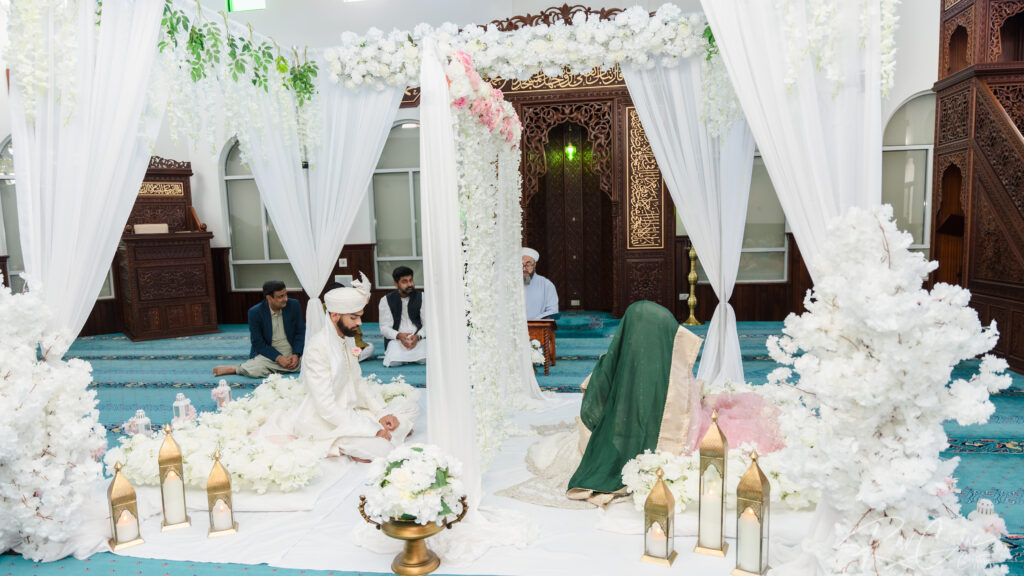
The Nikah is the heart of the wedding, the Islamic marriage contract, and it is an intimate ceremony that can take place in a home, a function centre, or a mosque. Each setting carries its own considerations.
Lighting. Many Nikah ceremonies happen in spaces with difficult mixed light, warm tungsten from chandeliers, cool daylight from windows, and sometimes coloured uplighting from the decorator all at once. That mix creates unpredictable colour casts, and managing it is a genuine technical skill. Ask your photographer directly how they handle mixed lighting, because it is one of the clearest ways to tell an experienced wedding photographer from someone learning on your day.
The Mahr and the signing. The Mahr, the gift from the groom to the bride, and the signing of the nikah-nama are quiet but significant moments that deserve to be photographed with care rather than rushed past.
The acceptance. The moment of acceptance, whether it is the qubool said aloud or the signing before witnesses, is the centrepiece of the Nikah. It happens quickly and it happens once. Your photographer needs to be in position before it begins, not moving into place as it starts. We always brief the exact sequence with the Imam or Qazi beforehand so we know precisely where to be and when, and so we do so in a way that respects the sanctity of the ceremony rather than intruding on it. Has your photographer arranged to speak with your Imam or Qazi before the ceremony?
Couple Portraits and the Melbourne Light
Protect a minimum of forty five to sixty minutes for couple portraits immediately after the Nikah, while the bride’s outfit and makeup are at their best. This is often the only dedicated portrait time in the entire wedding, so do not let a running-late schedule swallow it.
If your portraits can catch the hour before sunset, the Melbourne light will do beautiful work. That golden window falls late in summer, around seven thirty to eight thirty in the evening, and much earlier in winter, sometimes before five. Know your sunset time for your date and plan the portraits around it rather than around a fixed clock. Do you know roughly when the sun sets on your wedding date?
The Rukhsati
For many families the Rukhsati, the bride’s farewell as she leaves with her husband, is one of the most emotional moments of the entire wedding. It is also one of the most commonly left to whatever time happens to be left over. Give it a real place in the run sheet and let your family know when it is happening, so everyone is present and ready rather than scattered. It is a moment you cannot re-shoot, and it deserves the space it asks for.
The Walima
The Walima is the celebration of the marriage, traditionally hosted by the groom’s family, and it is where the wider community comes together.
Decoration and your outfits. The most common Walima mistake is outfit colours that compete with or vanish into the decoration. Share your outfit colours with your decorator before the stage and table palette is finalised, so you stand out from the background rather than blend into it.
Music and energy, if you are having it. If your celebration includes music and dancing, book a DJ who genuinely understands your community, whether that is Arabic, South Asian, Turkish, or a blend, and who can read a mixed room. A DJ who only knows one style will leave dead patches in the evening. If your family prefers the Walima without music, then the energy comes from the gathering itself, and good warm lighting and a smooth run sheet matter even more.
Lighting. Warm uplighting around the room flatters skin and outfits and does more for your photos than almost anything else. If the venue has harsh white overheads, ask whether they can be dimmed for the key moments. Has your decorator or venue confirmed the lighting plan for the Walima?
Photography Etiquette and Sharing
Discuss image sharing before the day, not after. Agree with your family which photographs may be shared publicly and which are kept private, particularly any from the women’s section. A good studio will honour these boundaries without needing to be reminded, and will ask rather than assume. Setting this out clearly in advance protects everyone’s comfort and trust. Have you agreed with your family on what may and may not be shared online?
Things to Never Skip
Coverage that includes a woman for the bride’s side if your wedding is segregated. This is the one that cannot be fixed afterwards.
A proper couple portrait session, protected and unrushed, ideally at both the Nikah and the Walima.
A briefing between your photographer and your Imam or Qazi on the Nikah sequence before the ceremony begins.
A written timeline shared with every vendor at least a week before the day.
A clear agreement with your family about which images may be shared and which stay private.
Frequently Asked Questions
Do we really need a female photographer?
If your wedding is segregated, or the women’s section is a hijab-free space, then yes. A male photographer cannot cover the bride and her guests in that setting, so a woman on the bride’s side is the only way that half of your day gets documented at all.
Can the Nikah and Walima be on the same day?
Yes, and many Melbourne couples do exactly that. The key is a genuine buffer between the ceremony and the reception so everyone can rest, change, and travel without a scramble.
What if our family does not want music at the wedding?
That is completely normal and respected. Your coverage does not depend on music at all. The warmth of the gathering, the ceremony, and the family moments carry the film, and good lighting and a smooth timeline matter even more in that setting.
How do we handle photos of women who remove their hijab?
Agree the boundaries in advance. Typically those images are captured only by a female photographer and are kept private rather than shared publicly. A respectful studio will ask and follow your family’s wishes without needing to be told twice.
When is the best light for portraits in Melbourne?
The hour before sunset, which is late evening in summer and mid to late afternoon in winter. Tell me your wedding date and I can tell you roughly when your golden hour will fall.
Let Us Tell Your Story
South Asian and Muslim weddings are our speciality, and we understand the rituals, the sensitivities, and the coverage your day genuinely needs, including providing a female photographer or videographer for the bride’s side when your wedding calls for it. If you would like an honest conversation about how your specific day would be covered, send me the details and I will happily walk through it with you.
Call or WhatsApp: 0403 760 005
Email: hello@ravweddings.com.au
Instagram: @rav.weddings
ravweddings.com.au/contact
Rattan, Rav Weddings. 7+ years and 150+ South Asian weddings across Melbourne and Sydney.
Of everything ahead, which part of your wedding are you most unsure how to cover?

Written by
Rattan — Rav Weddings
7+ years · 150+ South Asian weddings · Melbourne & Sydney
Ready to Begin?
Let's Tell Your Story
South Asian weddings are our speciality — we understand every ritual, every tradition, every moment.
Get in Touch