
By Rattan · Rav Weddings, Melbourne
If you are reading this at night with a notes app full of half-finished plans, you are exactly who this guide is for. A Sikh wedding is a long day with a lot of people who each have an opinion about what should happen next, and the fear underneath most of the planning is a quiet one: that the day will feel rushed, that you will spend it watching the clock instead of living it, and that the moments you actually wanted will get swallowed by the running around.
After more than 150 South Asian weddings across Melbourne and Sydney, I can tell you the couples who end up with the calmest days and the most beautiful films are almost never the ones with the biggest budget. They are the ones who planned a realistic timeline and protected it. That is the whole secret, and this guide walks you through it from the first pre-wedding function all the way to the last dance.
Before You Plan Anything, Decide One Thing: Morning or Afternoon Anand Karaj
Everything in your timeline hangs off this single decision, so make it first.
A morning Anand Karaj, starting around 9:00 or 10:00am, is the traditional and most common choice in Melbourne. It gives you a full, unhurried day and the best possible light for portraits in the late afternoon. The trade-off is an early start, which means getting-ready can begin before sunrise in winter.
An afternoon Anand Karaj compresses everything and often pushes your portraits and Vidaai into low light, especially in the Melbourne winter when the sun sets before 5:30pm. It can work beautifully, but it needs tighter planning and usually a lighting setup for the reception entrance.
Once you know which one you are building around, the rest of the day falls into place. Have you locked your ceremony time with your Gurdwara yet, or is that still open?
The Days Before: Your Wedding Starts Earlier Than You Think
A complete timeline does not begin on the wedding morning. The pre-wedding functions are some of the warmest, most photogenic moments of the whole celebration, and they are often the least planned.
The Maiyan or Vatna, with the haldi and the singing, is pure joy and colour. Hold it somewhere with good natural light if you can, near a window or in a shaded outdoor spot, because harsh midday sun or a dark garage will fight the coverage.
The Mehndi and Sangeet carry the energy of the whole family, and the Choora and Kalire ceremony is one of the most emotional moments a bride experiences, often with just her closest family present. The Jaggo, late at night with the decorated pots and the dancing, is loud and beautiful and deserves proper coverage rather than being treated as an afterthought.
If your budget allows, having your photographer and videographer across these functions means your wedding film tells the whole story rather than starting cold on the wedding morning. Are your pre-wedding functions spread across separate days, or condensed into one big evening?
A Real Sample Timeline: A Morning Anand Karaj, Start to Finish
Here is what a workable Melbourne wedding day actually looks like with real times. Adjust it to your ceremony time, but keep the buffers. The buffers are not padding. They are what stop the whole day collapsing when one thing runs late, and something always runs late.
6:00am to 6:30am, Getting ready begins. Bride’s hair and makeup starts. Allow two and a half to three hours minimum for the bride, and roughly one hour for the groom. Rushed getting-ready is visible in the photos, in the tense shoulders and the half-finished details.
8:30am, Turban tying and sehra. The groom’s dastaar and sehra sequence is one of the most beautiful parts of the getting-ready coverage. Give it room. It needs time, space, and good light, not a cramped corner five minutes before leaving.
9:00am, Baraat and Milni. Plan 30 to 45 minutes. It always runs longer than anyone thinks. The garlands, the greetings, the elders meeting, none of it can be hurried, and you would not want it to be.
9:45am to 10:00am, Groom’s entry into the Darbar Sahib. A short but important window. More on protecting it below.
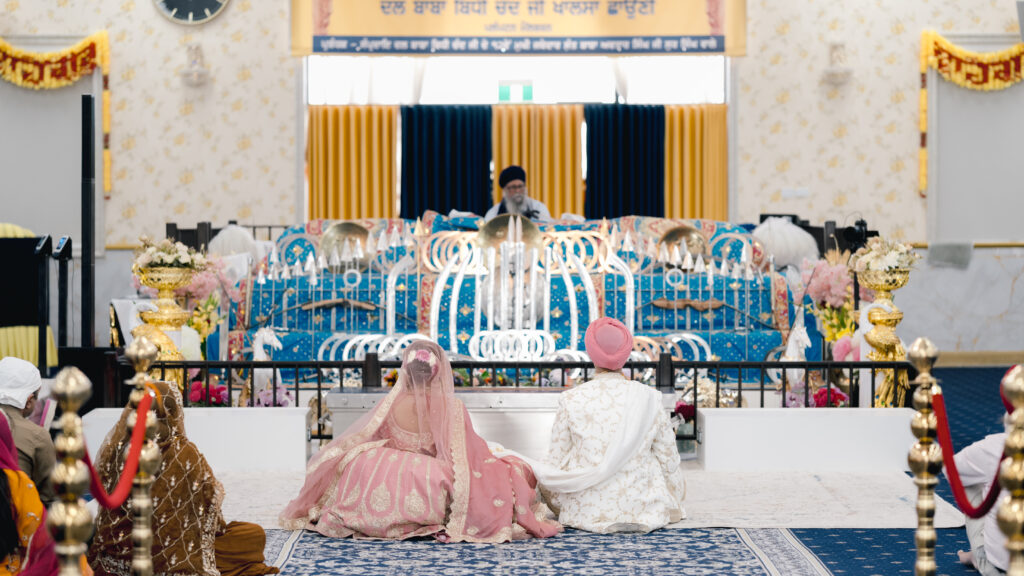
10:00am to 12:00pm, Anand Karaj. Depending on the Gurdwara and the kirtan, the ceremony runs anywhere from one and a half to two and a half hours, including the Lavaan.
12:00pm to 1:30pm, Langar and family formals. People are relaxed and fed, and this is the natural time for group photographs. Allow 60 to 90 minutes for formals. Have your list of family combinations written down and give it to a confident relative who can call names out, because tracking down a missing uncle eats time faster than anything else.
1:30pm to 2:00pm, Vidaai. Give it a real start time in the run sheet. A rushed Vidaai and a planned one produce completely different coverage, and this is a moment you cannot re-shoot.
Afternoon, Rest and buffer. Genuinely build this in. Everyone needs to breathe, change, and travel to the reception venue without a panic.
Golden hour, Couple portraits. This is where the Melbourne light does the work, and it is worth planning your reception entry around it. In summer that golden window falls late, roughly 7:30 to 8:30pm. In winter it can be as early as 4:00 to 5:00pm, which means you may want portraits before the reception rather than during it. Know your sunset time for your date and plan backwards from it.
Evening, Reception. Plan three to four hours of coverage minimum for the entrance, speeches, first dance, cake, and the dancing. If the Anand Karaj was in the afternoon, the reception will run later and you will want a lighting plan.
The single most useful thing you can do with this timeline is share it with every vendor at least two weeks out, so the caterer, the decorator, the Gurdwara, and your photography team are all working from the same page. Would it help if I built this into a printable one-page run sheet you could hand to your family?
Booking a Gurdwara Hall That Is Too Small
Small halls create real problems for coverage. When the Darbar Sahib is tight, guests are packed close, the photographer has nowhere to move, the angles collapse, and the lighting tends to be harsher and less flattering.
When you visit a Gurdwara to book, walk into the hall and picture it full. If 150 people are seated in here, is there any room left for a photographer to move around the couple during the Lavaan? If the honest answer is barely, either look at a larger venue or manage your guest count. This one decision affects your coverage more than almost anything else, and it is invisible until the day itself.
Checking the Sehra and Kalangi the Night Before
The sehra is one of the most photographed elements of the groom’s morning, and it is also one of the most commonly rushed. Do a full check the evening before. Wear it for twenty minutes and move around in it. Make sure the flowers are being sourced fresh on the morning, not left out overnight, and have the kalangi pinned and checked by whoever is tying the turban, rather than balanced on top and hoped for the best. A wilted sehra or a crooked kalangi is a small thing that shows up in every single photo of the entry.
Never Making New Plans on the Wedding Morning
The morning of the wedding is not the time to decide you want portraits at a different location, or to add a ceremony segment nobody discussed, or to shift the timeline. Every unplanned change on the day creates a chain reaction that pushes into the next thing, and the next.
Lock your plan at least two weeks before. Share it with every vendor. Then trust it, and let the day carry you rather than the other way around.
Protecting the Two Entries: The Groom’s and the Bride’s
The groom’s first walk into the Gurdwara is one of the most photographable moments of the day, and it is routinely lost to family walking in front of the lens, phones held up blocking sightlines, and the groom moving too fast. Brief the baraat the night before. Ask them simply to give the groom a clear path and a moment to enter with presence.
The bride’s entry matters just as much. Before she has even had a chance to walk in, people often surge ahead to bow first, and her moment disappears. Ask your family the evening before to let the bride enter and settle first, and for everyone else to follow. It costs nothing and it changes everything.
Giving the Couple Space During the Lavaan
During the four rounds, the most powerful images come when the couple looks calm and undirected, not surrounded and boxed in. Ask your family to leave room around the couple so the photographer can move with the Lavaan rather than shooting over shoulders. A photographer who cannot move during the rounds cannot cover them properly, and these are the images you will hang on your wall.
Never Leaving the Vidaai to the Last Minute
The Vidaai is consistently the most under-planned moment of a Sikh wedding, left to whatever time happens to be left over. Do not do that to it. Put it in the run sheet as a real segment with a real start time, and tell your family when it is happening so everyone is present and ready rather than scattered. It is one of the most emotional moments of the entire day, and it deserves to be given the space it asks for.
A Few More Things Worth Planning For
Ask your MC to make a brief, warm announcement during the ceremony inviting guests to be present and to let the professional team handle the recording, so the aisle is not a wall of raised phones.
Know your outdoor portrait location before the day. Driving around Melbourne looking for a nice spot while the clock ticks is one of the most common ways portrait time quietly disappears.
Have a weather backup for portraits. This is Melbourne, and a plan that only works in sunshine is not a plan. A good indoor or covered option means a surprise shower becomes a non-event rather than a crisis.
Frequently Asked Questions
How long does an Anand Karaj take?
Usually between one and a half and two and a half hours, depending on the Gurdwara and the length of the kirtan. Ask your Gurdwara directly, because it varies more than people expect.
Can we do the Anand Karaj and the reception on the same day?
Yes, and most Melbourne couples do. The key is a genuine afternoon buffer between the two so everyone can rest, change, and travel without a scramble.
What time should getting ready start?
For a morning ceremony, brides generally need to start hair and makeup around two and a half to three hours before they need to leave. Groomsmen and the turban sequence need roughly an hour and a half all up. When in doubt, start earlier. Nobody has ever regretted extra time in the morning.
Do we really need a second shooter?
For a Sikh wedding, it makes a real difference. The getting-ready happens in two places at once, and during the ceremony one camera covers the wide sacred moments while the other captures the close emotion. One person cannot be in both places, and the day does not pause.
When is the best light for portraits in Melbourne?
The hour before sunset, every time. In summer that is late evening, and in winter it can be mid to late afternoon, so your portrait timing should follow the season rather than a fixed clock. Tell me your wedding date and I can tell you roughly when your golden hour will fall.
Let Us Plan Your Day Together
South Asian weddings are our speciality, and understanding the timeline, the rituals, and the light is exactly what we do before we ever pick up a camera. If you would like, send me your ceremony date and the Gurdwara you are considering, and I will happily walk through what a realistic run sheet looks like for your specific day.
Call or WhatsApp: 0403 760 005
Email: hello@ravweddings.com.au
Instagram: @rav.weddings
ravweddings.com.au/contact
Rattan, Rav Weddings. 7+ years and 150+ South Asian weddings across Melbourne and Sydney.

Written by
Rattan — Rav Weddings
7+ years · 150+ South Asian weddings · Melbourne & Sydney
Ready to Begin?
Let's Tell Your Story
South Asian weddings are our speciality — we understand every ritual, every tradition, every moment.
Get in Touch