
By Rattan · Rav Weddings, Melbourne
A Hindu wedding is one of the most layered celebrations you will ever be part of, and no two families run it quite the same way. A North Indian ceremony, a Gujarati one, a South Indian muhurtham, a Bengali or a Marathi wedding each unfold differently, at different times of day, with their own rituals and their own rhythm. Some run late into the night, some begin at dawn on an auspicious muhurat, and the pre-wedding days can stretch across a week of colour and family.
What every couple shares is the same quiet worry: that with so many rituals and so many relatives, the day will move too fast and the moments that matter will blur past before anyone can hold them. After covering many Hindu weddings across Melbourne and Sydney, here is what actually protects those moments, from the first pre-wedding function to the last of the Vidaai. Treat the sample timeline below as one common shape and adjust it to your own tradition and to what your Pandit Ji has planned.
The Days Before: Where the Celebration Really Begins
A complete Hindu wedding does not start on the wedding morning. The functions leading up to it are some of the warmest and most photogenic of the whole celebration, and they are the ones most often treated as casual and left under-covered.
The Ganesh Puja or Grah Shanti opens the proceedings with prayer and intention. The Mehndi fills a room with colour and detail. The Sangeet is pure energy, family and friends performing and dancing. The Haldi, with its turmeric and laughter, is joyful and messy and beautiful, and it photographs best in good light, so hold it somewhere bright rather than in a dark garage or a dim hall.
If your budget allows, having your photographer and videographer across these functions means your wedding film tells the whole story rather than beginning cold on the ceremony morning. Are your pre-wedding functions being covered, or only the wedding day itself?
Start With a Realistic Timeline
When the day is rushed, it shows in every photo and every frame of video. The rituals, from the Jaimala to the Saat Pheras to the Sindoor, each carry weight and deserve time. A workable Hindu wedding day looks something like this, though yours will shift with your tradition:
Bridal preparation, two to three hours minimum. Not squeezed, not rushed. Rushed getting-ready is visible in the photos.
Groom getting ready, one to one and a half hours, including the pagri and sehra.
Baraat arrival, forty five minutes to an hour, including the welcome, the Milni, and the Jaimala.
The ceremony, two to three hours, depending on Pandit Ji and the rituals included.
Family formals and couple portraits, sixty to ninety minutes, immediately after the ceremony while outfits are still fresh.
Vidaai, thirty to forty five minutes. Plan this as a real segment, not an afterthought.
Travel and reception buffer. Build a genuine gap here so nobody is scrambling.
Reception, three to four hours minimum of coverage.
Build your day around this structure and protect it. Every section that gets compressed has a cost, and that cost shows up in your gallery. Once your run sheet is set, share it with every vendor at least a week out. Has your Pandit Ji confirmed the ritual order and rough timing yet?
The Sehra and Pagri: Try Them On Before the Day
The sehra and pagri need to be tried on and worn properly before the wedding morning. Wear the pagri for at least thirty minutes. Move around, sit down, check that it feels secure.
If the pagri is uncomfortable, the groom will unconsciously adjust it all day, and the tension shows in his face and his body language in every frame. Check the sehra for durability and fit too. Sort this the evening before. It takes twenty minutes and it protects hours of coverage.
Choosing the Right Mandap: This Affects Everything
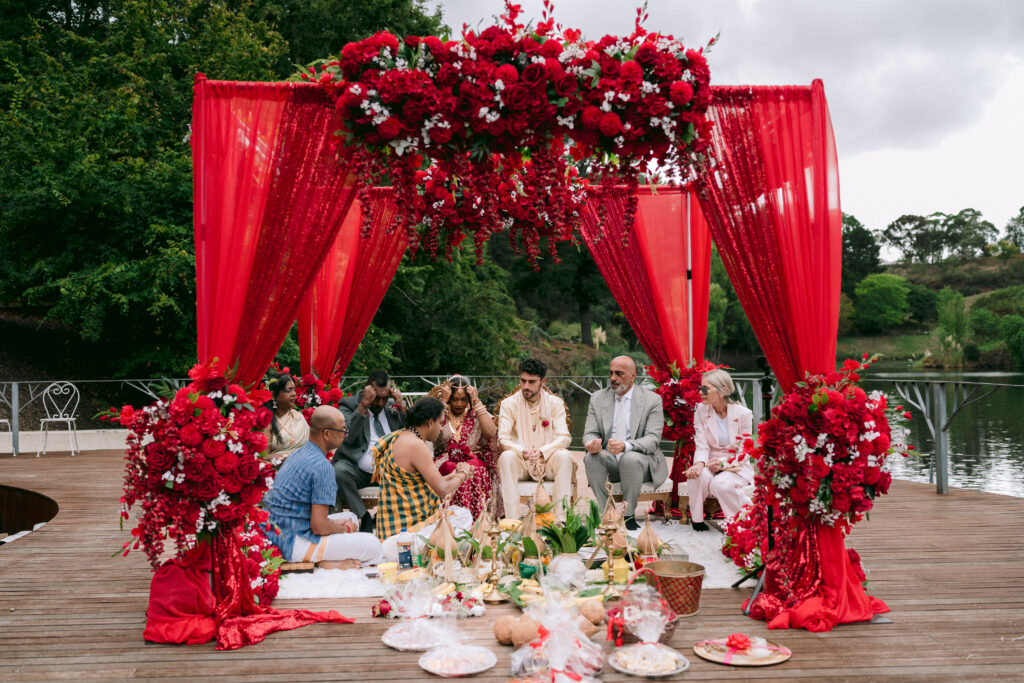
The mandap is the centrepiece of your entire ceremony. Every significant ritual happens inside it or directly in front of it, so the structure you choose shapes every photograph.
A closed mandap with four pillars and solid sides creates real challenges. The pillars block sightlines, parents seated inside get hidden behind columns, and shadows fall unevenly across faces. Once the pheras begin with family also inside, a closed structure becomes congested.
An open mandap is significantly better for coverage, more angles, more light, and fewer obstructions. If you can choose, choose open. Do you know yet whether your venue or decorator is planning an open or closed mandap?
An Open Mandap in Daylight: The Sun Is Not Your Friend
When one side of the mandap sits in direct sun and the other in shade, one face is blown out and the other falls dark, and no editing fixes that split. Make sure your mandap has a solid cover on top so the light falls evenly across both of you, and talk to your decorator specifically about this.
Melbourne weather is genuinely unpredictable, so have a written backup plan for an outdoor ceremony. Two to three hours in direct sun also shows in every photo, in the squinting and the discomfort, which cannot be edited out. Does your outdoor ceremony have a real wet-weather and shade plan in writing?
The Background Behind an Open Mandap
A plain wall, a garden, a drape, or a floral backdrop behind the mandap gives every shot a clean, intentional frame. A cluttered background of chairs, cables, and passing guests undoes even the best mandap. Talk to your decorator about the background before you finalise where the mandap is placed.
Give Your Photographer Space Around the Mandap
Your photographer and videographer need to move around the mandap during the ceremony. At minimum, one to two metres of clear space on each side makes a significant difference to what can be captured. When the mandap is jammed against a wall or boxed in by seating, half the angles simply disappear.
The Saat Pheras: Keep the Mandap Clear
As the couple begins the pheras, family crowd in, guests stand, and phones go up, and what should be a clear, intimate frame becomes a wall of people and screens. Brief your family before the ceremony and ask them to remain seated during the pheras, and ask your MC to make a warm announcement to guests. The pheras happen once, and they deserve a clear frame.
Havan Smoke and What It Does to Footage
The sacred fire is beautiful, and the smoke it produces can fill the frame with haze in photos and obscure the couple in video. A good photographer works around it, but some frames will still be affected, and it helps to know that in advance so your expectations are realistic rather than disappointed.
No Last Minute Ritual Inclusions
Adding a ritual on the morning of the wedding creates timing problems that flow through the whole rest of the day. If there is a ritual you want included that was not in the original plan, speak to Pandit Ji at least a week before and adjust your run sheet accordingly.
Coordinate With Pandit Ji Before the Day
Meet with Pandit Ji before the wedding day and understand the order of rituals. When your photographer knows the ceremony structure, they can anticipate moments instead of reacting to them, and that is the difference between catching the Sindoor moment and just missing it.
Set up a speaker or PA system so guests can actually hear the ceremony. Guests who cannot hear become restless, drift to the back, and check their phones, and all of that ends up in your background.
Decoration That Complements Your Outfits
Share photos of your outfits with your decorator early. If your bridal lehenga and your mandap decoration are heavily embellished in the same tones, everything blends into one busy frame. The couple should stand out from the decoration, not disappear into it. Has your decorator seen your outfit colours yet?
Couple Portraits and the Melbourne Light
Protect at minimum forty five to sixty minutes for couple portraits immediately after the ceremony, while outfits and makeup are still intact. These are the images you will look at for the rest of your life, so treat them accordingly.
If those portraits can catch the hour before sunset, the Melbourne light does beautiful work. That golden window falls late in summer, around seven thirty to eight thirty in the evening, and much earlier in winter, sometimes before five. Know your sunset time for your date and plan the portraits around it rather than around a fixed clock. Do you know roughly when the sun sets on your wedding date?
Vidaai: Protect This Time
The Vidaai needs to be planned as a real segment with a real start time, thirty to forty five minutes minimum, not left as a chaotic afterthought at the end. Tell your family when it is happening so everyone is present and ready rather than scattered. It is one of the most emotional moments of the entire day, and you cannot re-shoot it.
A Note on the Reception
Plan three to four hours of coverage for the reception, covering the entrance, speeches, first dance if you are having one, and the dancing. Two things quietly decide how it photographs: the venue’s lighting and your decor. Warm uplighting flatters skin and outfits far more than harsh white overheads, so ask whether the venue lights can be dimmed for the key moments. And if you want a particular look, remember the room dictates it. A bright white hall cannot produce dark, moody images, and a very dark venue fights an airy, light-filled style. Choose the venue that already lives in the look you want.
Frequently Asked Questions
How long does a Hindu wedding ceremony take?
Usually two to three hours, though it varies widely by tradition and by Pandit Ji. A South Indian muhurtham, a Gujarati ceremony, and a North Indian one can differ significantly, so ask your priest for a realistic estimate for your specific rituals.
Should the mandap be open or closed?
For photography and videography, open is far better. It gives more light, more angles, and fewer blocked sightlines. If it is outdoors, make sure it has a solid top cover so the light falls evenly on both faces.
Do we need a second shooter?
For a Hindu wedding it makes a real difference. Getting-ready happens in two places at once, and during the ceremony one camera holds the wide sacred frame while the other catches the close emotion. One person cannot be in both places, and the ceremony does not pause.
How do we stop guests blocking the pheras with their phones?
A brief, warm request from your MC, plus a quiet word to close family beforehand asking them to stay seated. It costs nothing and it protects the single most important frames of the ceremony.
When is the best light for portraits in Melbourne?
The hour before sunset, which is late evening in summer and mid to late afternoon in winter. Tell me your wedding date and I can tell you roughly when your golden hour will fall.
Let Us Tell Your Story
South Asian weddings are our speciality, and understanding every ritual, every tradition, and the light your day needs is exactly what we do before we ever pick up a camera. If you would like, send me your ceremony date and the venue or mandap you are considering, and I will happily walk through what a realistic run sheet looks like for your specific day.
Call or WhatsApp: 0403 760 005
Email: hello@ravweddings.com.au
Instagram: @rav.weddings
ravweddings.com.au/contact
Rattan, Rav Weddings. 7+ years and 150+ South Asian weddings across Melbourne and Sydney.
Of all the rituals in your day, which one are you most worried about fitting in?

Written by
Rattan — Rav Weddings
7+ years · 150+ South Asian weddings · Melbourne & Sydney
Ready to Begin?
Let's Tell Your Story
South Asian weddings are our speciality — we understand every ritual, every tradition, every moment.
Get in Touch